Back to Case Studies
Case Study 04 · PlexTrac · 2022–2023
Streamline Security Testing: Exercises, Emulation & Efficient Execution
TL;DR
Led the 0-to-1 redesign of PlexTrac's Runbooks module, building a structured exercise workflow with MITRE ATT&CK integration and adversary emulation support. Reduced engagement setup time by 45%, grew new engagements run by 18%, and established design patterns carried forward into the broader PlexTrac design system.
My Role
Principal Designer, Product Manager & Design Leadership
01
Product & design lead
Owned the end-to-end design and product management for the Runbooks refactor — from problem framing and user research through to shipped features.
02
User research
Conducted initial user research and customer pain point discovery. Identified that users needed exercise workflows, not just runbook storage.
03
Journey mapping
Built a platform-agnostic journey map covering the full testing lifecycle — from initial assessment through findings, triage, report, validation, and closing the loop.
04
Design system leadership
Maintained design consistency across the growing team while scaling the feature set — establishing patterns reused across Runbooks and adjacent modules.
Design Approach
Three principles shaped the solution
1
Build for the full exercise lifecycle
Don't just store runbooks — enable teams to plan, execute, track, and retest within a single connected workflow. Each phase should hand off naturally to the next.
2
Make ATT&CK accessible, not intimidating
500+ MITRE procedures are only useful if teams can find, filter, and apply them quickly. The library needed to feel like a tool, not a reference document.
3
Support a growing team without breaking consistency
As the design team scaled, the Runbooks module needed shared patterns that multiple designers could build on without diverging from the broader PlexTrac system.
The Solution
View Runbooks 2.0 prototype in Figma
Key Screens & Features
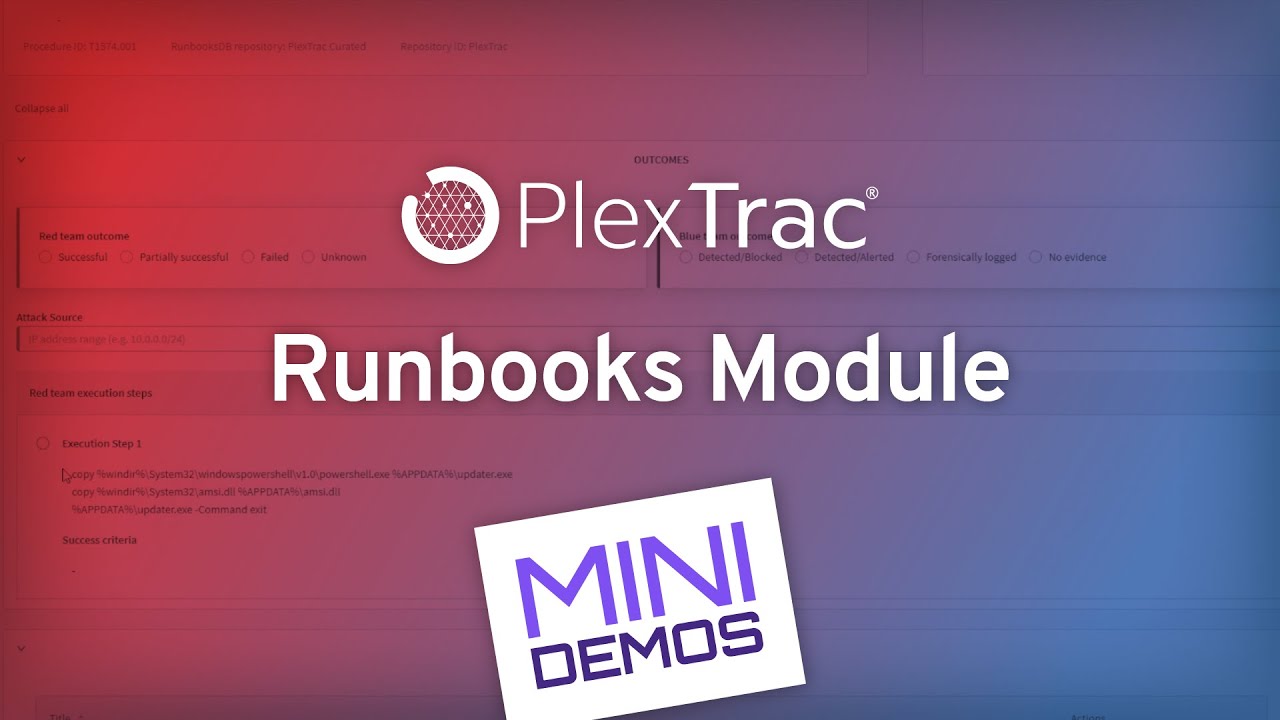
The refactored Runbooks module introduced a structured exercise workflow with MITRE ATT&CK integration, adversary emulation support, and iterative progress tracking.
Exercise Setup Wizard
A guided setup flow allowing teams to scope an exercise, select a methodology, and pull in relevant ATT&CK procedures — reducing time-to-start for new engagements.
Runbook Coverage & Heatmap
Visual ATT&CK coverage mapping showing which tactics and techniques had been tested, in progress, or not yet covered.
Runbook: Procedures
Browsable, filterable library of 500+ MITRE ATT&CK procedures with the ability to add custom procedures and group them into reusable runbook templates.
PlexTrac Content Library
Curated library of pre-built test plans from MITRE Engenuity, BlindSPOT, and SCYTHE — enabling adversary emulation without starting from scratch.
Runbooks: Engagements List
Central dashboard showing all active and completed exercises with status, coverage percentage, and team assignments at a glance.
Engagement Details
Deep-dive view per engagement showing procedure execution status, linked findings, assigned team members, and progress toward completion.
Indexing & Tracklist
Structured index of all procedures run within an engagement, with pass/fail status and direct links to findings — enabling iterative retest tracking.
Outcomes
What this work delivered
45%
Reduction in time spent setting up an engagement
18%
Growth in new engagements run post-launch
↑ ARR
Retention & adoption metrics improving
Delivered a structured exercise workflow connecting planning, execution, findings, and retest for the first time in a single platform experience
Enabled adversary emulation through integration with MITRE Engenuity, BlindSPOT, and SCYTHE — giving red teams credible, repeatable threat scenarios
Design patterns established in this module were carried forward into the broader PlexTrac design system, reducing future ramp-up time across the team
Reflection
What I'd do differently
If I were doing it again, I'd push to instrument baseline metrics earlier — specifically, engagement setup time and retest completion rates. Having those benchmarks before launch would have made the post-launch story much sharper and easier to attribute directly to design decisions.